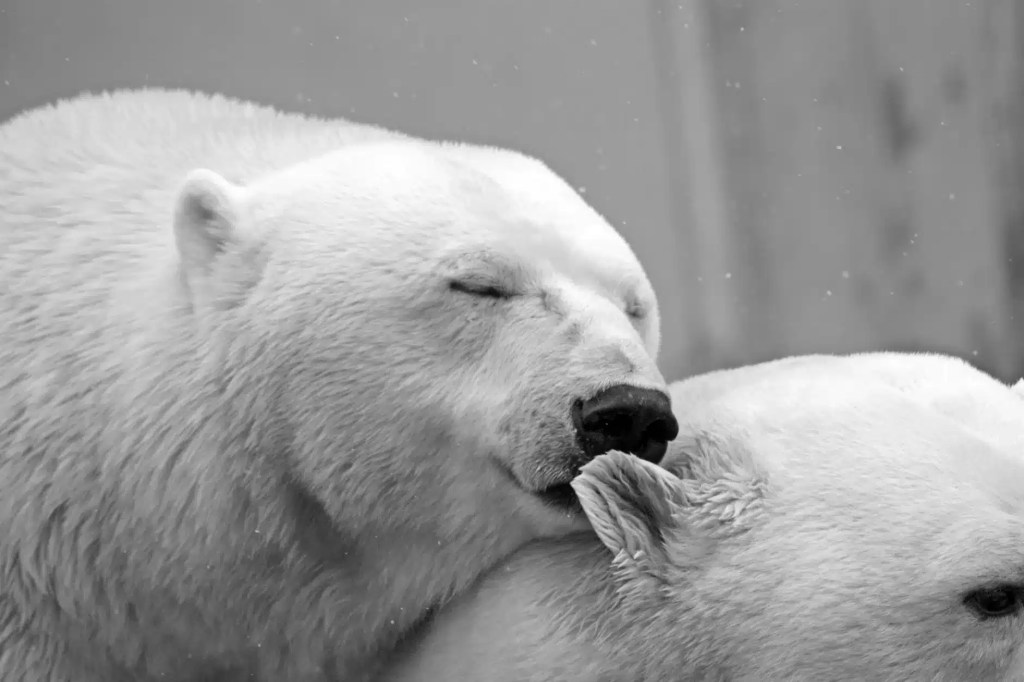
Memoirs of a Polar Bear by Yoko Tawada tells the story of three generations of anthropomorphic polar bears – this intergenerational element is an aspect common in Tawada’s work.
The opening act tells of the grandmother who after spending years performing in the circus, retires to an administrative position, where she tackles the bureaucracy of conferences and finally attempts to pursue her dream of writing an autobiography by recovering memories from her youth.
The following act follows the story of her daughter Tosca from the perspective of her human trainer and their quest towards their shared goals, although it seems that Tosca may actually be narrating the story of Barbara telling the story of Tosca. The final act is about the grandson, Knut, who struggles to find his place in the world. Then again, it seems to be implied that the latter acts are imaginary ‘futures’ written the grandmother of the first act, leading to a paradoxical narrative which blurs the boundary between reality and fiction, the past and the present, just as the line between human and animal is blurred by Tawada.
The polar bears in the story understand human language, but do not belong to the human world. This encompasses the magic realism genre of the story – unfamiliarity that has been made familiar in some way.
Magic realism is a literary genre that is “characterised by the matter-of-fact inclusion of fantastic or mythical elements into seemingly realistic fiction” (Encyclopædia Britannica). The polar bears have some semblance of autonomy in the novel’s universe, yet at the same are distant from it. For instance, the novel begins with the grandmother polar bear recalling being tortured at the circus by the circus owner, highlighting her subordinate position in comparison to humans, yet simultaneously, she has the capability of human awareness. There is also constant talk of “human rights” being implemented in aid of the polar bear, which of course blurs the human-animal division.
Yoko Tawada is a Japanese writer who was born in Tokyo in 1960.
After completing her degree in literature in Japan, she moved to Hamburg in 1982 (Perloff, 2005). She writes in both languages and thus is what Chantal Wright describes as an “exophonic” writer, in that she “adopts a literary language other than her mother tongue, entirely replacing or complementing her native language as a vehicle of literary expression” (Wright, 2013). This is known as Ekkyō bungaku in Japanese, the literature of transgression. Much of her work is written from the perspective of an outsider living in a foreign culture, and Memoirs of a Polar Bear is no different.
In this novel, Tawada explores a metamorphosis which is not just physical (animal-human; human-animal), but which also concerns linguistic hybridity. She is an exponent of a so-called new kind of literature that reflects on language and national identity.
In the novel, the grandmother polar bear, like many expats, goes through the process of learning a new language as she is exiled from her native Moscow to East Germany and later dreams of migrating to Canada. She is forced to come to terms with the idea of nationality and belonging, of reconciling her ancestral tongue with her new literary language (just as Tawada herself did).
Interestingly, the bicycle is used as a constant motif for immigration and displacement; the grandmother polar bear asserts that “in the near future, bicycles will conquer all the world’s major cities” although the official, like many stanch right-wing politicians of today, is against it (“a bicycle culture could exert problematic influence on our society”) Tawada fervently looks to explore the hardships of finding “self-representation in a language so patently unlike one’s own” (Perloff, 2005), and thus the grandmother, who appears to be a semi-autobiographical representation of Tawada herself, becomes the symbol of resoluteness in a time of unrest and displacement as she experiences ‘otherness’ and is confronted with the trials and tribulations of being an “ethnic minority” in her new country of residence – she is triumphant in her struggle, however, proclaiming: “my bicycle is my language”.
Another key technique of magic realism employed in Memoirs of a Polar Bear, is the ‘typical’ ordinary narrative being undercut by comedic and bawdy turns of narrative, which are almost alien to familiarity but add a light-hearted touch to the stories at play.
The grandmother recounts how she “opened [her] anus to the cosmos and felt it in [her] bowels”, she contemplates sex between herself and a sea lion – “nature had made [their] bodies incompatible”, his “was moist and slippery, while [hers] was dry and rough” – and there is mention of an actor who reeks of “soap, sweat, and sperm”. Notwithstanding this, the fundamental cruciality to the novel is that despite its fantastical and slapstick elements, its core is based in reality – an aspect I enjoyed spotting. We see hints of this reflected throughout the narrative. For illustration, we see aspects of discrimination (the grandmother is bullied on the school playground as a child, being called “snout face” and “snow baby” for her breed); exploitation (sugar cubes and chocolate bars used as salary); the monotony of work life (“stuck in a dead end, doing the minimum necessary for survival”); and even misogyny, dotted throughout.
If we were to enter into a discourse about class, we could say that Sea Lion is the representation of the bourgeoise ‘elite’.
He does not want to confront the “political criticism” in the grandmother’s manuscript. He believes that her “experiences are important, not [her] thoughts”, which is an ideology akin to misogynistic thought. The grandmother sees herself as “flattering, submissive and dependent”, which is reflective of the view of women in patriarchal society, also.
The polar bears in the story have an acquired ability to traverse human society, they speak and walk bipedally in a narrative told within a historically factual setting, yet the why or how is never explained. They each become micro reflections of our society, relatable on their journey to personal success and navigating the world around them; we are able to connect with each of them at a certain point, despite how unnerving it did sometimes feel to be pulled out of the narrative occasionally on a bizarre magic-realism induced tangent.
Works Cited
Magic realism entry Online. <https://www.britannica.com/art/magic-realism>
PERLOFF, M. 2005. TLS Books of the Year. The Times Literary Supplement.
TAWADA, Y. 2017. Memoirs of a Polar Bear. Translated from German by Susan Bernofsky. London: Portobello Books.
WRIGHT, C. 2013. Yoko Tawada’s Exophonic Texts. Yoko Tawada’s Portrait of a Tongue. University of Ottawa Press.
Bibliography
AUSUBEL, R. 2016. Humans and Polar Bears Share Dreams in This Novel. The New York Times.



 ACreativeGirlNadia
Leave a comment