
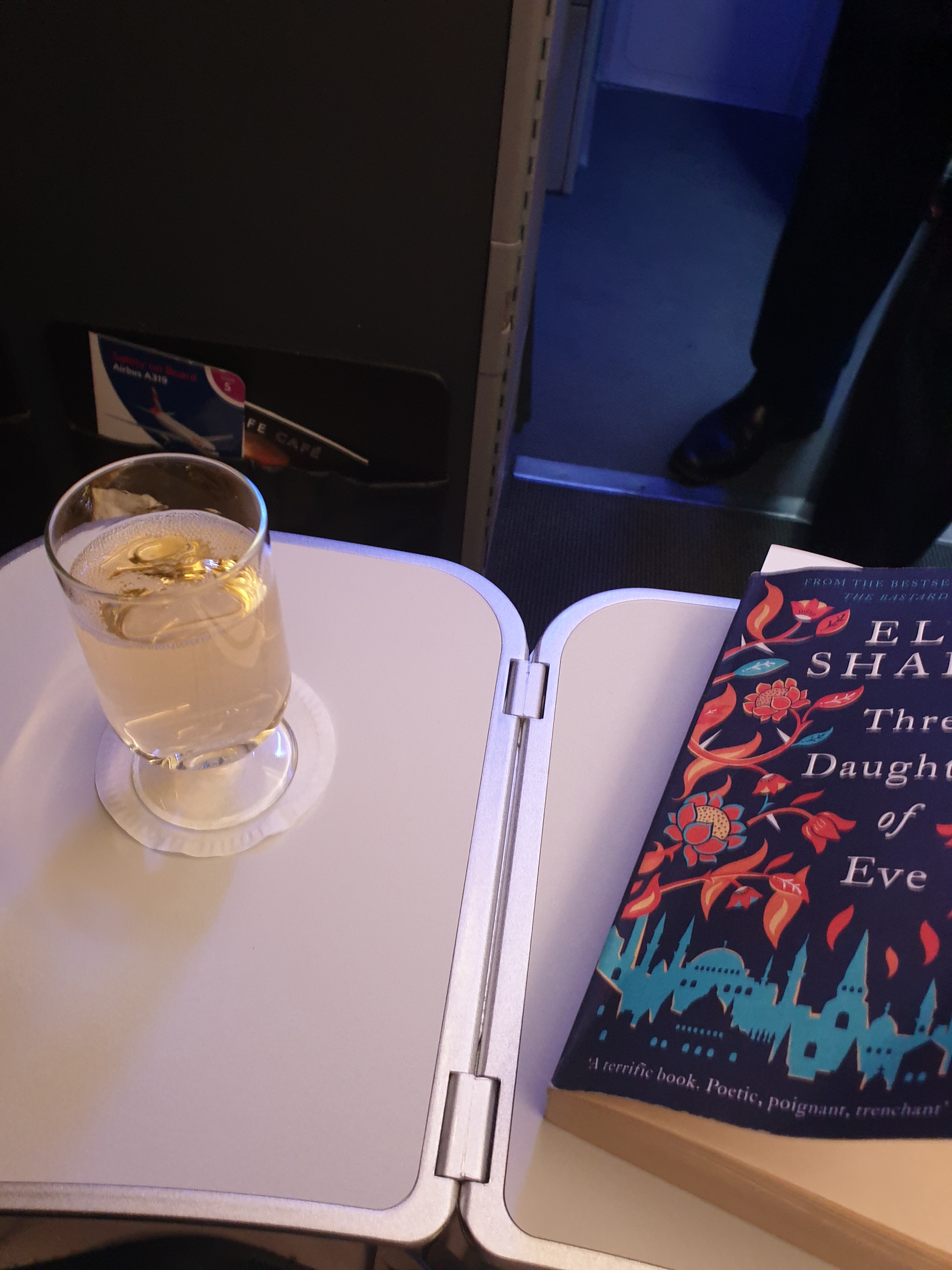
Three Daughters of Eve – which in many places was recalled and retitled Confused Quest – depicts an internal and external conflict between secularism/modernity and religion/traditionalism. This is further emphasised through Peri Nalbantoğlu’s inner struggle to appease both her mother – who looks for peace and meaning in religion and more conservative values – and her secular father – who yearns for Western ideals and strongly believes that this will advance Turkey and its society.
“They [Mensur and Selma] were as incompatible as tavern and mosque.”
“…the Nalbantoğlu household was divided into her zone and his zone – Dar al-Islam and Dar al-harp – the realm of submission and the realm of war.”
Peri is the intermediary between both her parents.
“All of that put Peri, the youngest child, in an awkward position, with both parents striving to win her over; her very existence became a battleground between competing worldviews. The thought that she had to make a choice, once and for all, between her mother’s defiant religiosity and her father’s defiant materialism almost paralysed her.”
This, in turn, reflects Istanbul’s own clash between traditional conservatism and modern secularism. At the same time, Peri grapples with her quest for self-discovery and identity.
“God was a maze without a map, a circle without a centre; the pieces of a jigsaw puzzle that never seemed to fit together. If only she could solve this mystery, she could bring meaning to senselessness, reason to madness, order to chaos, and perhaps, too, she could learn to be happy.”
The narrative beautifully intertwines and equally navigates Peri’s past and present; her past in Oxford in the UK and her present as a housewife in Turkey, where she is still coming to terms with who she is and her place in society.
“A fine wife, a fine mother, a fine housewife, a fine citizen, a fine modern Muslim she was.”
“Three Muslim women in Oxford: the Sinner, the Believer and the Confused.”
Elif Shafak, Three Daughters of Eve
“No stranger to faith, no stranger to doubt.”
As present-day Peri sits with the upper-class of Istanbul, she remarks on their hypocrisy: maintaining the traditionalist status-quo but benefitting from Western influence.
“Peri thought there was something hypocritical about the capitalist class in this part of the world. On the outside they were professedly conservative and for the status quo; inside they seethed with fury and frustration.”
“Amidst uncertainty, unlike their counterparts in Europe, the local bourgeoisie had neither audacity nor autonomy, neither tradition nor memory – squeezed between what they were expected to be and what they wished to be. Not so unlike me, Peri thought to herself.”
Elif Shafak, Three Daughters of Eve
Elif Shafak has crafted a remarkable character-driven narrative that explores themes of faith and doubt in Turkey. Through her skillful storytelling, Shafak unveils the complexities of human emotions and the struggles that arise from a society steeped in tradition yet grappling with modernity. Peri is flawed yet relatable, embodying the inner conflicts that many individuals face in their quest for identity and belonging. Her journey is not merely a personal one; it resonates with the larger existential questions surrounding faith, culture, and personal belief systems in a rapidly changing world. The ending leaves you in suspense, uncertain about what Peri’s next moments will hold for her.




 ACreativeGirlNadia
Leave a comment