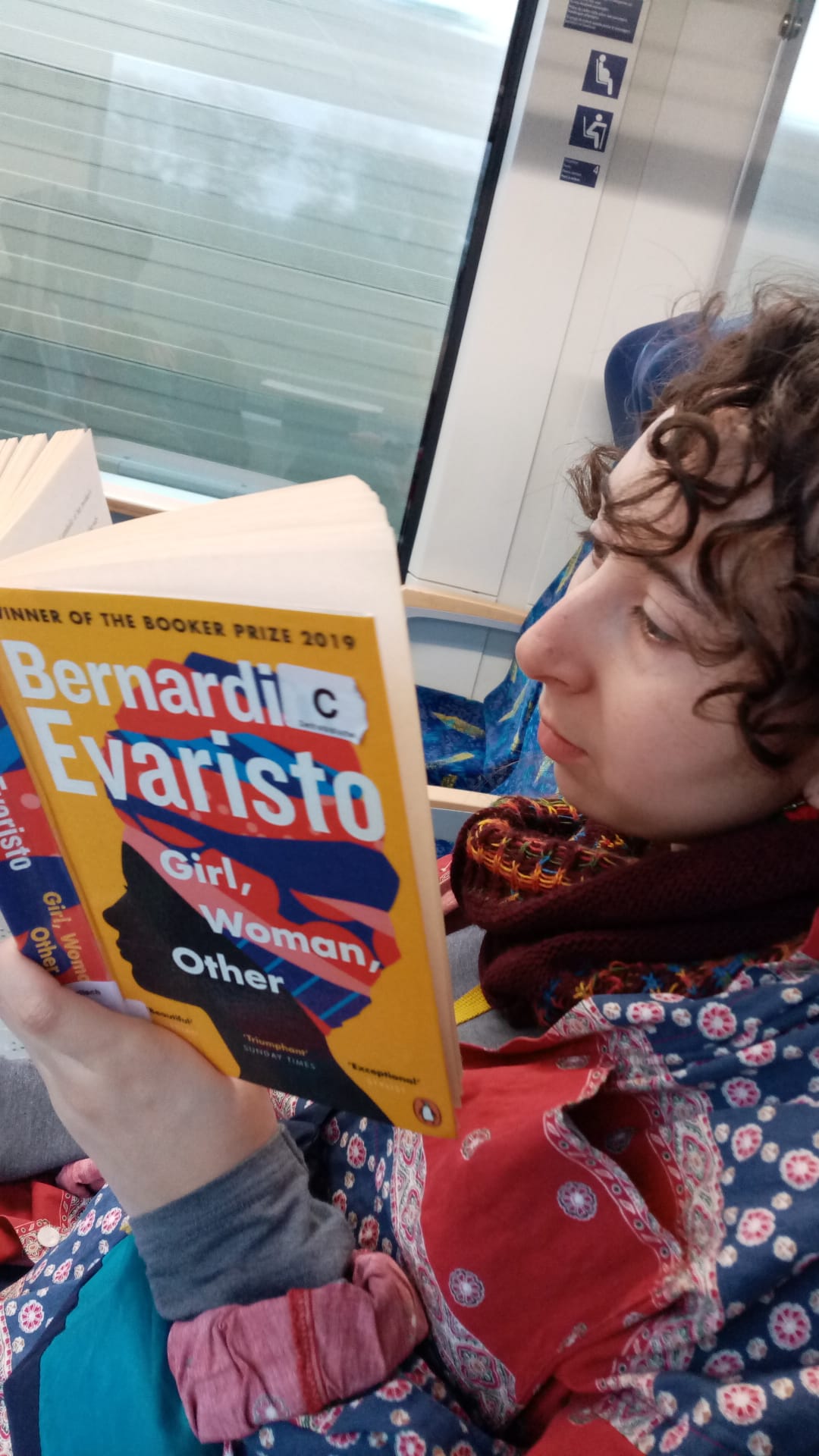
BOOK REVIEW: ‘Girl, Woman, Other’ by Bernardine Evaristo
‘Girl, Woman, Other’ by Bernardine Evaristo follows the intricacies and complexities of womanhood, privilege and feminism. Written in a non-traditionalist narrative form, this novel tells non-traditionalist stories of womanhood and otherhood.
We have Yass, the university student finding herself, learning that it’s okay for teenage ideals and values to be challenged. Her university friend challenging her on the notion of privilege. Privilege is not so binary; where does being a person of colour put her on the hierarchical privilege pyramid – if there even is one. We realise that it is more nuanced than that, a fact that Yazz has to unpick whilst in conversation with Courtney, her friend from University:
“Courtney replied that seeing as Yazz is the daughter of a professor and a very well-known theatre director, she’s hardly underprivileged herself, whereas she, Courtney, comes from a really poor community where it’s normal to be working in a factory at sixteen and have your first child as a single mother at seventeen, and that her father’s farm is effectively owned by the bank…
…Waris who is the most oppressed of all of them (although don’t tell her that) in five categories: black, Muslim, female, poor, hijabed”
Page 66
Is there a truly a hierarchy of privilege? And if so, what is the basis for measuring it? How do we pit a trans person of colour like Morgan against a lesbian person of colour like Dominique? Dominique, who also has a problem with “trans troublemakers” (page 437). The truth is: we can’t. We can’t play “privilege Olympics” – people, circumstances, contexts are non-comparable.
The book serves as a reminder that we are imperfect people. Just because someone fights for and supports one group of marginalised people, it does not mean that they are an ally for every marginalised group. Dominique excluding trans people from her women’s festival is an example of this. Shirley is an example of this.
Page 240:
“She wanted teacher-pleasers, that’s the truth of it
not gun-wielding, gum-chewing, coke-sniffing, up-the-duff, scumbag gangster thugs”.
Shirley echoes the sentiments on the stereotypes of ‘young black kids’, despite the fact she was once in their very place. Although she is a black woman who came from a working-class background (she has fought against her obstacles to better her life and supports the kids at the school which she sees have potential), eventually, she too becomes disengaged and desensitised, and she joins Penelope’s side.
She later proclaims: “middle classes über alles!” (page 240), a phrasing evocative of Nazi dogma to emphasise her delight at having climbed the class ladder. She describes the pigeons which intrude in her garden and steal the food of “goldfinches, blue tits, wrens and the fearless robins” as “Nazi bully boys” (page 243), furthering on this allegory but additionally stressing Shirley’s hypocrisy – she uses Nazi phrasing herself, whilst also describing intervening pests as so – pests comparable to her perceived view of the “scumbag gangster thugs” in her school who encroach on her time when she could be helping “child prodigies” in the private sector.
I’ve not ever read a novel that touches on so many prevalent discussions of today; racism, post-partum depression, sexism, homophobia, transphobia, classism – and the list goes on. Intergenerational histories tie together beautifully and Evaristo intertwines tales of love and generational and personal traumas in a way that I have never seen before. Each character carries their own personal shame – Winsome at sleeping with Lennox, her daughter’s husband, Hattie’s secret baby, Bummi’s fling with a woman, Carole changing her accent, hair style and clothes to fit in with the white academic elite.
This novel also questions the idea of identity. For example, Carole and Roland reject labels of ‘blackness or ‘gayness’, whilst Amma and Bummi are empowered by such labels. Roland snubs such categorisations as, in his opinion, these are not “conscious political decisions”, but factors which are “genetically determined… psychically and psychologically pre-disposed.” As he puts it: “white people are only required to represent themselves, not an entire race” (page 415). And in this way, through her characters, Evaristo highlights the subjectivity of self-identifying; what may provide people with strength and a sense of belonging, may also alienate others.
Having grown up in working-class London, to parents from two different nationalities different to the one I grew up in, the stories told by Bernardine Evaristo’s characters really resonated with me. They reminded me of my own, of my peers’, those of the people that surrounded me; my struggles with identity, fitting in and yet simultaneously wanting to belong to where I came from. I delighted in the anecdotal structure of the book, getting to peek into each character’s world through excerpts of their lives – each distinct yet somehow related. I guess it is like humanity, we each battle with our own internal turmoil, but at the end of the day, we share the fact that we all struggle with aspects in our lives. ‘Girl, Woman, Other’ was, for me, thought-provokingly groundbreaking.
Discover more from
Subscribe to get the latest posts sent to your email.